Urban Renewal
Revitalizing Post-Pandemic Downtowns: Looking to Detroit for Inspiration

Many downtowns across the United States continue to feel the effects of the COVID-19 pandemic. Empty streets and storefronts, declining populations, fewer visitors, and economic decline are now haunting cities that were previously lively and thriving. While the pandemic was unprecedented, this story of seemingly irreversible urban decline has been seen before.
Detroit was once the wealthiest city in the world and one of the most populous in the US due to the automobile industry’s boom in the 1940s and 50s. Car companies like Ford, General Motors, and Chrysler employed hundreds of thousands of employees and provided fair wages to workers, creating a wealthy city economy built on an industrial middle class. However, as Japanese and German auto manufacturers outcompeted domestic production, Detroit began a slow and painful decline.
By 2013, Detroit had declared bankruptcy and large swathes of the city were abandoned. National news was screening harrowing images of decay, empty homes, and deteriorating landmarks, as well as sharing frightening metrics about crime and poverty. While this was a difficult year, it also marked the beginning of a new Detroit.
Today, Detroit has a steadily increasing population for the first time in decades. The city has a growing tech and startup ecosystem, new investment in electric vehicle manufacturing, and prominent headquarters relocating from the suburbs to the city centre. New community initiatives, such as urban farms, youth development programs, and homelessness support, are emerging across the city. Even landmarks, like the Michigan Central Station or the David Whitney Building, have been restored to their former glory.
While still ongoing, Detroit’s revitalization has set an example for struggling downtowns everywhere. This article breaks down some key factors that have contributed to its transformation, mapping out potential avenues for other cities to follow.
Affordability
One of Detroit’s greatest assets in its revitalization has been something that many larger cities struggle to provide: affordability. Detroit has historically offered relatively low-cost real estate, with rental prices dropping dramatically after their declaration of bankruptcy in 2013. This affordability created space for entrepreneurs, artists, small businesses, and new residents to take a chance on the city.
Affordability has helped support Detroit’s growing startup ecosystem. Lower commercial rents and relatively affordable housing allow entrepreneurs to establish themselves without facing the same costs associated with other major American cities. For startups and small businesses, this can be the difference between an idea and a reality.
Affordability can also help cities attract new residents. As housing costs continue to rise across the country, struggling downtowns have an opportunity to position themselves as places where young professionals, entrepreneurs, artists, and families can afford to build a life. Detroit has used its relatively affordable real estate as a foundation for attracting people who may otherwise be priced out of larger metropolitan areas.
For post-pandemic downtowns, this presents an important lesson: affordability can be an economic development strategy. Rather than trying to recreate the high-cost downtowns or luxury offerings of the past, cities can embrace the space created by lower property values to attract new businesses, residents, and ideas.
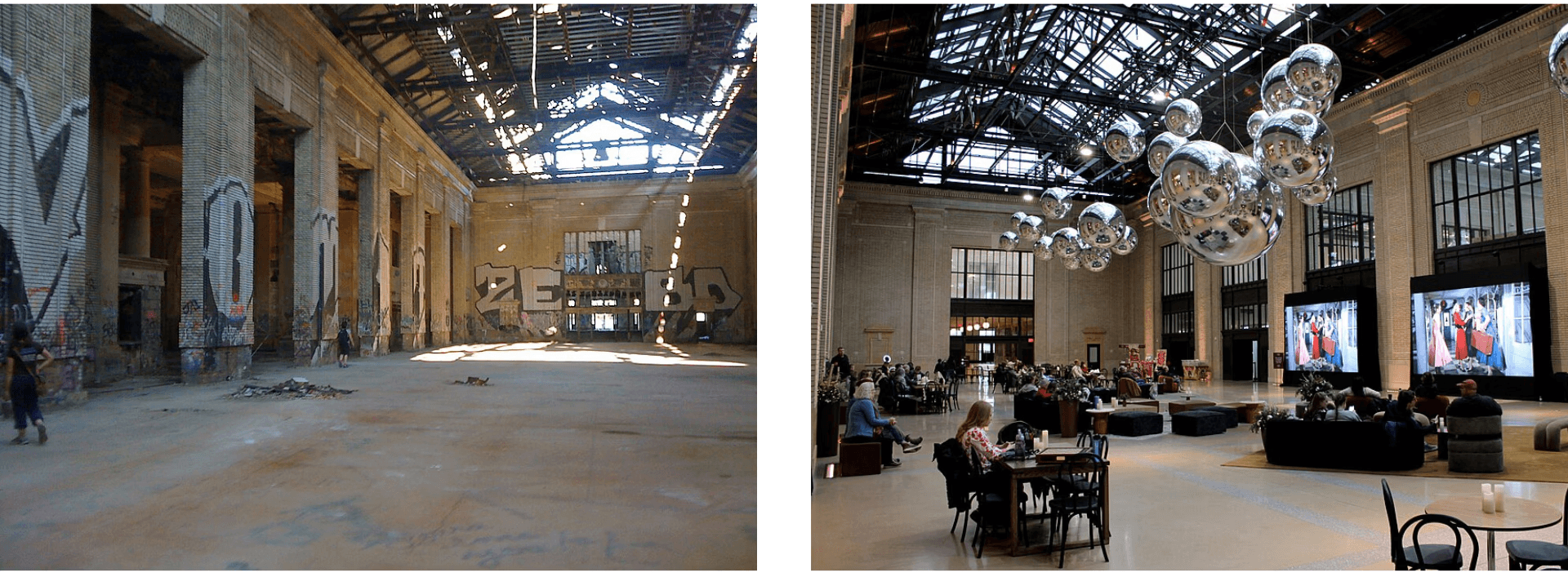
Michigan Central Station - before and after renovation.
Private and Public Investment
Detroit’s revitalization would not have been possible without both private and public investment. Public investment often comes first, through improving sidewalks, infrastructure, parks, and mobility. Detroit has signalled its willingness to invest in itself by building a new public transit route, the QLINE, planning a new waterfront park, and improving infrastructure throughout the downtown. This communicates that there is a future in Detroit, and increases confidence for potential private investors.
Indeed, big names like JPMorgan Chase, Dan Gilbert, and Bloomberg have since supported massive redevelopment and renewal projects across the city, often in partnership with public agencies. Detroit has become lauded for adaptive reuse, where historic buildings from the city’s heyday have been preserved, restored, and repurposed. The city’s iconic Art Deco and Italian Renaissance buildings, like the Book Tower or the Wurlitzer Building, have been returned to their former glory and adapted to serve modern needs.
Michigan Central Station is another leading example, being saved from demolition in 2018 when Ford purchased the deteriorating and waterlogged landmark. Now, it is freshly renovated and home to over 100 startups in a new mobility innovation campus. This speaks to the local legacy of Ford; once responsible for the downfall of the city, Ford is reinvesting in Detroit and supporting fresh alternatives, such as electric vehicles.
Together, public and private investment work to preserve Detroit’s unique history and strengthen the city’s collective identity as it undergoes a major transition. Investment in landmark buildings, as well as public spaces, infrastructure, and parks, communicates that these places still have value — and that there is a future worth investing in.
For other downtowns, this is an important lesson. Public investment does not need to solve every problem itself. Instead, it can help create the conditions for private investment, entrepreneurship, and community activity to follow.

Eastern Market pop-up stand.
Community Initiatives
The most well-known community development initiatives in Detroit are centered around food systems. A variety of urban farms, markets, community pantries, and food assistance programs have emerged across the city in recent decades. Many of these initiatives are a direct response to racial injustices in Detroit’s food systems - historical disinvestment in Black neighbourhoods and the arrival of suburban, big box grocery options left many inner-city and communities of color without access to healthy, affordable food. Now, community-led programs are aiming to increase local ownership, food access, and health through creating alternative food systems which are more responsive to community needs.
Many of these programs operate in connection to the Eastern Market, which covers over 20 acres and has been operational since 1891. Within the market, there are several food assistance programs to support low-income residents, such as the Double Up Food Bucks Program or the Supplemental Nutrition Assistance Program. The Food Box Program acts as a coordinating body, connecting farmers with local buyers, while the Detroit Kitchen Connect Program supports young food entrepreneurs. The market also supports multiple pop-ups around the city, targeting underserved communities and often partnering with schools, community centers, and churches.
Detroit’s alternative food systems serve as a shining example of how cities can directly respond to place-specific struggles. While not every downtown faces food insecurity like Detroit, the Eastern Market shows how cities can leverage historical landmarks to respond to modern problems, build diverse and resilient ecosystems of support, and create city-wide impact.
Conclusion
A major ingredient in Detroit’s success is the creation of new narratives in the media. From horrific stories and images in 2013 to stories highlighting successful community initiatives, restoration projects, and new investment, Detroit is now seen as a comeback story. The first steps in any city may seem risky or pointless, yet they may be the first steps toward reclaiming your city’s identity and self esteem.
Detroit’s story demonstrates that downtown revitalization does not happen overnight, nor does it come from a single large project. It is the result of many smaller pieces working together: affordable space for entrepreneurs, investment in public infrastructure, private-sector confidence, new residents, adaptive reuse, and community initiatives that respond directly to local needs. Most importantly, these efforts have helped Detroit develop a new identity without erasing the history that came before it.
This is perhaps the most important lesson for post-pandemic downtowns. Cities do not need to return to exactly what they were before 2020. The downtown of the future may look different from the downtown of the past, with new businesses, new residents, new uses for old buildings, and new ways of bringing people together. The challenge is to recognize these changes as an opportunity rather than a sign of decline.
Detroit’s recovery is still a work in progress, but its transformation shows that even cities that once seemed to be in irreversible decline can build a new future. For communities currently struggling with empty storefronts, declining foot traffic, or uncertainty about what comes next, Detroit offers an important reminder: revitalization starts with believing that a place is worth investing in — and then giving people the opportunity to do so.
If you’re looking to explore how your city can rebound too, consider reaching out to HSC for tailored planning and economic development support.
Sources:
Architales. “How America’s Most Broken City Is Fixing Itself.” 29 May 2026.
Bence, Sarah. “Adaptive Reuse in Detroit: Transforming Historic Buildings | Visit Detroit.” 2018.
Bergman, Zinette, and Manfred Max Bergman. “Toward Sustainable Communities: A Case Study of the Eastern Market in Detroit.” Sustainability, vol. 14, no. 7, 1 Apr. 2022, p. 4187, 10.3390/su14074187.
Pothukuchi, Kameshwari. “Five Decades of Community Food Planning in Detroit.” Journal of Planning Education and Research, vol. 35, no. 4, 26 June 2015, pp. 419–434, 10.1177/0739456x15586630.